The Education-Jobs Gap by D W Livingstone
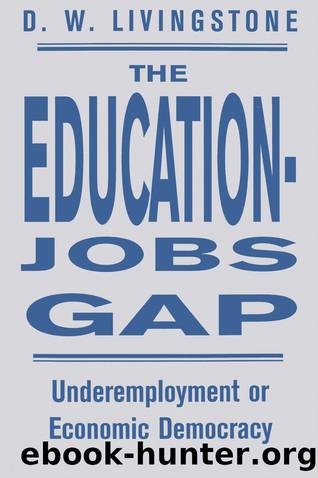
Author:D W Livingstone [Livingstone, D W]
Language: eng
Format: epub
Tags: Political Science, Public Policy, Economic Policy, Education, Student Life & Student Affairs, Labor & Industrial Relations
ISBN: 9781551930176
Google: sSSK2UbKYhsC
Barnesnoble:
Publisher: Eliot Werner Publications
Published: 1999-01-01T02:40:32+00:00
The major consequence of this status competition is credential inflation. That is, increasing numbers of occupational groups use credentials provided by the formal educational system, credentials which are often far beyond the production requirements of their work, to construct and maintain positions for themselves in the labor market. The empirical analysis focusses on four of the biggest and most important professions in modem society: medicine, law, engineering and teaching, and their comparative success in shaping educational programs to ensure the distinctive cultures and self-conscious organization of their occupational communities. Collins (1979,181) ends up positing a kind of credential plutocracy in which the most mobilized occupational communities bargain among themselves for ever greater self regulatory powers, so that "the ongoing process of reform in America, as different private groups enter the bargaining, only serves to make private property interests ever more strongly entrenched."
In typical Weberian fashion, Collins (1979, 72, 203-4) expects increasing fragmentation into more closed occupational castes in the foreseeable future. He has been criticised for attributing an exaggerated power to credentialed groups while cynically reducing the substance of credentialed knowledge, and also largely ignoring noncredentialist bases of power and stratification (Morrow and Torres 1995,201-204). Others have supplemented Collins' historical analysis of the expansion of the U.S. higher education system by documenting the role of business interests (particularly land speculators) in the decentralized launching of the college system, while refuting his view that multi-ethnic conflict was the driving force of this expansion (Brown 1995). Whatever the limitations, Collins' work remains the most systematic attempt to explain what I have called in prior chapters the performance gap, the discrepancy between people's actual knowledge and the technical or production requirements of their current jobs.
Ironically, however, his emphasis on the position-shaping powers of occupational groups discourages any specific attention to the credential gap per se, the discrepancy between the education acquired by job entrants and required by employers. Indeed, the thrust of Collins' theory is to suggest ever tighter links between occupational communities and required credentials, even as the performance gap between actual and required technical knowledge continues to inflate. He does recognize that in the 1960s "the credential system went into a state of explicit crisis" (Collins 1979, 191), as credentials no longer guaranteed jobs. The only way he can begin to account for this tendency is to appeal beyond the dynamics of the credential system to its "interaction with the struggle for economic position and with the level of economic productivity" (194).4 But he does little more than allude to the continuing problems of unemployment and underemployment, and the rough and crisis-prone balance between the absorption of surplus labor and the breeding of student disillusion by the educational system, otherwise called "the credential system of occupational placement" (195). To explain most fundamental aspects of underemployment requires recourse to theories that give greater continuing importance to conflicts between employers and current and prospective employees over conditions of work, without denying the power of specialized occupational communities to shape access to and requirements for their own positions in the class structure of work.
Download
This site does not store any files on its server. We only index and link to content provided by other sites. Please contact the content providers to delete copyright contents if any and email us, we'll remove relevant links or contents immediately.
Spell It Out by David Crystal(36116)
Life for Me Ain't Been No Crystal Stair by Susan Sheehan(35810)
Cecilia; Or, Memoirs of an Heiress — Volume 1 by Fanny Burney(32558)
The Great Music City by Andrea Baker(32018)
Cecilia; Or, Memoirs of an Heiress — Volume 2 by Fanny Burney(31956)
Cecilia; Or, Memoirs of an Heiress — Volume 3 by Fanny Burney(31941)
Professional Troublemaker by Luvvie Ajayi Jones(29662)
The Secret History by Donna Tartt(19085)
We're Going to Need More Wine by Gabrielle Union(19046)
Twilight of the Idols With the Antichrist and Ecce Homo by Friedrich Nietzsche(18632)
All the Missing Girls by Megan Miranda(16023)
Cat's cradle by Kurt Vonnegut(15351)
Pimp by Iceberg Slim(14506)
For the Love of Europe by Rick Steves(14121)
Bombshells: Glamour Girls of a Lifetime by Sullivan Steve(14073)
Talking to Strangers by Malcolm Gladwell(13370)
Norse Mythology by Gaiman Neil(13363)
Fifty Shades Freed by E L James(13239)
The Social Justice Warrior Handbook by Lisa De Pasquale(12190)
